


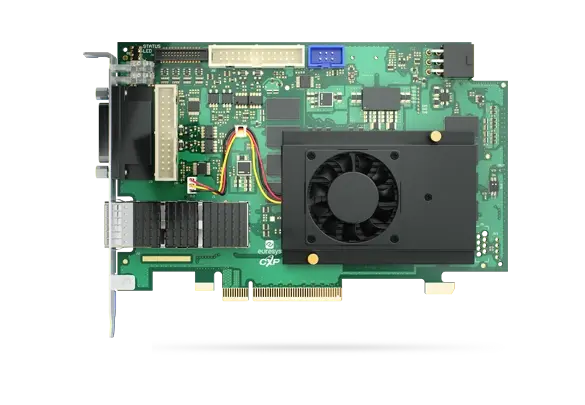
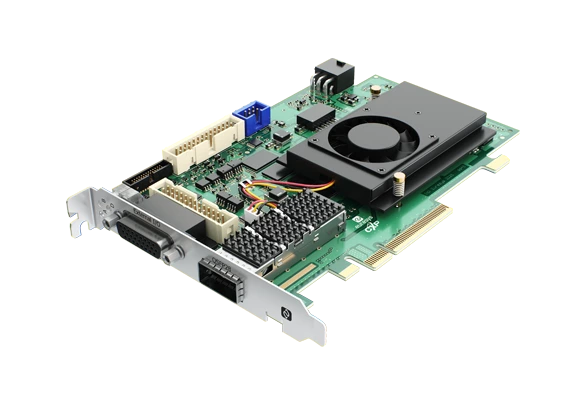
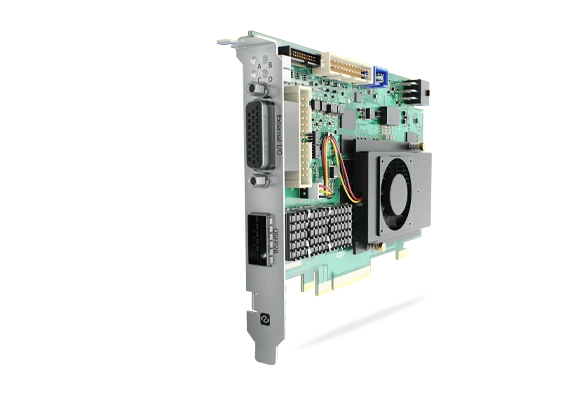
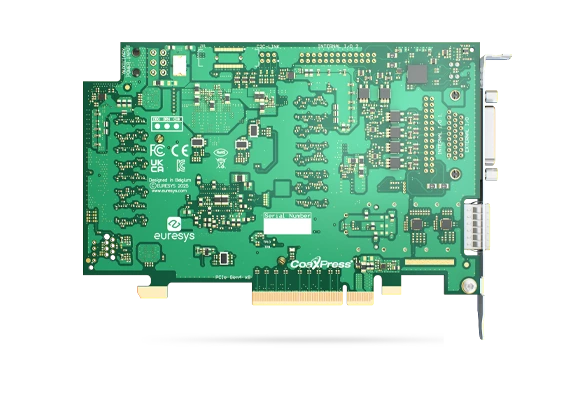
Coaxlink QSFP28
100G CoaXPress-over-Fiber frame grabber
- One QSFP28 port compliant with 100 Gbps optical modules
- Four-connection 25 Gbps CoaXPress-over-Fiber
- 12,500 MB/s camera bandwidth
- 8 GB of on-board memory
- PCIe 4.0 (Gen 4) x8 bus: 13,500 MB/s bus bandwidth
- Feature-rich set of 20 digital I/O lines
- Extensive camera control functions
- Memento Event Logging Tool
Highlights
CoaXPress-over-Fiber is a light but significant extension of the existing CoaXPress specification to support transport over fiber optics
By using fiber optics connectivity, CoaXPress-over-Fiber benefits from the almost unlimited cable lengths and reduced cable congestion (fiber optics are lighter and thinner than coaxial cables). By leveraging Ethernet Physical Layer standards (IEEE 802.3), CoaXPress-over-Fiber also benefits from the low-cost standard components (such as connectors and cables) and their constant evolution towards higher bandwidths.
Most importantly, CoaXPress-over-Fiber allows CoaXPress to go beyond the physical limitations of coaxial cables in terms of bitrate.

Support the next step in camera bandwidth
- Highest data acquisition rate in the industry
- Up to 12,500 MB/s camera bandwidth from camera to host PC memory
- One QSFP28 interface has the equivalent bandwidth of
- 10x CXP-12 connections
- 14x Camera Link Full connections
- 20x CXP-6 connections
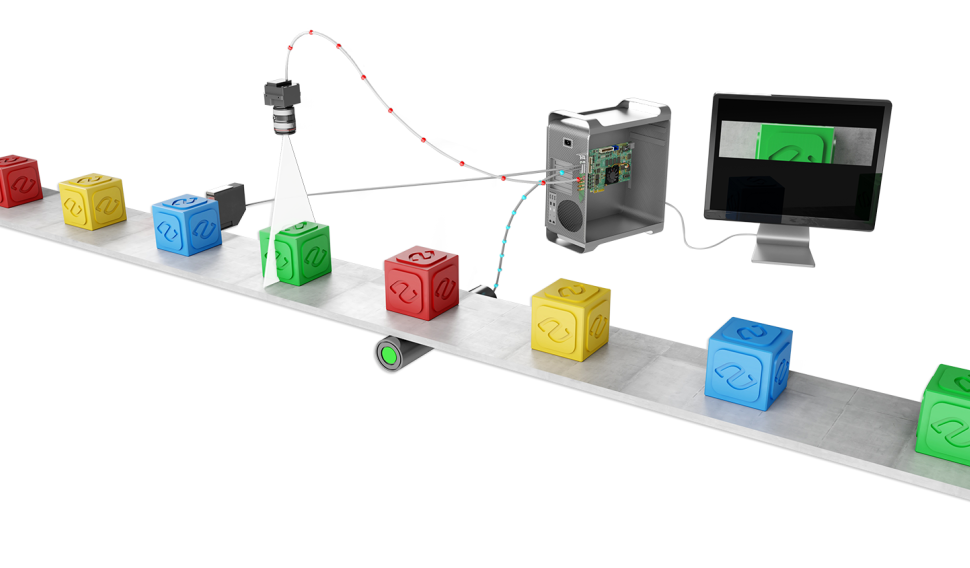
Line-Scan Triggering Capabilities
Allied Vision frame grabbers offer many capabilities to synchronize line-scan or 1D cameras, sensors and lighting controllers. Frame grabbers can control the camera scanning rate based on the signals received from a motion encoder.
They support continuous web scanning (to inspect infinite, continuously moving surfaces without losing a single line) and discrete object scanning (to acquire the image of objects moving in front of the camera).
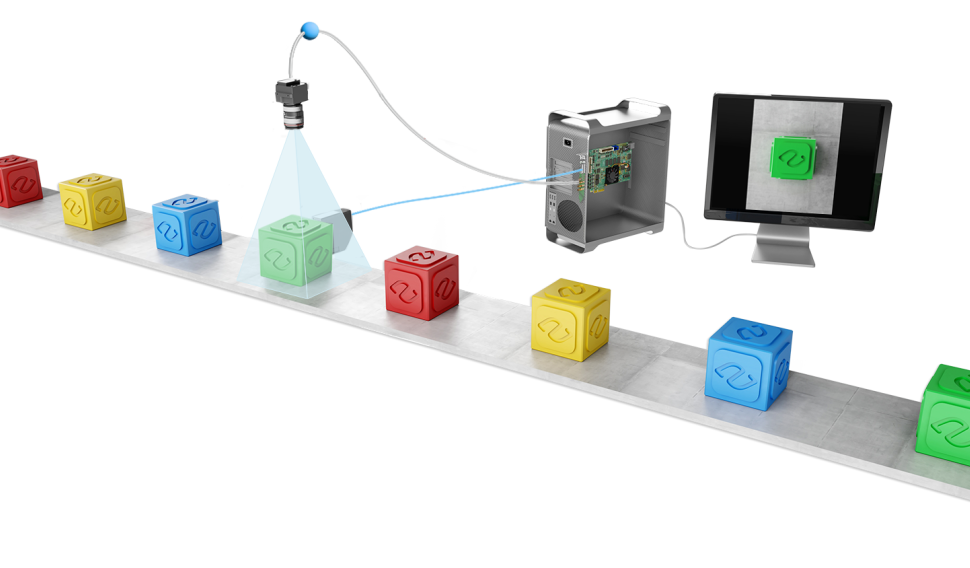
Area-Scan Triggering Capabilities
Allied Vision frame grabbers offer many capabilities to synchronize area-scan or 2D cameras, sensors and lighting controllers, for stationery or moving objects in the field of view, or moving cameras.
Benefits
Compatible With eGrabber
- eGrabber Studio: eGrabber’s interactive evaluation and demonstration application, giving access to GenICam features exposed by GenTL Producers
- GenTL Console: A command-line tool giving access to the functions and commands exposed by the Euresys GenTL Producers
PCIe 4.0 (Gen 4) x8 Bus
- 15,700 MB/s peak bus bandwidth
- 13,500 MB/s sustained bus bandwidth
Direct GPU Transfer
- Sample programs for AMD DirectGMA and NVIDIA (CUDA) available.
- Direct GPU transfer eliminates unnecessary system memory copies, lowers CPU overhead, and reduces latency, resulting in significant performance improvements in data transfer times for applications.
- Direct capture of image data to GPU memory is available using AMD’s DirectGMA. Compatible with AMD FirePro W5x00 and above and all AMD FirePro S series products.
High-Performance DMA (Direct Memory Access)
- Direct transfer into user-allocated memory
- Hardware scatter-gather support
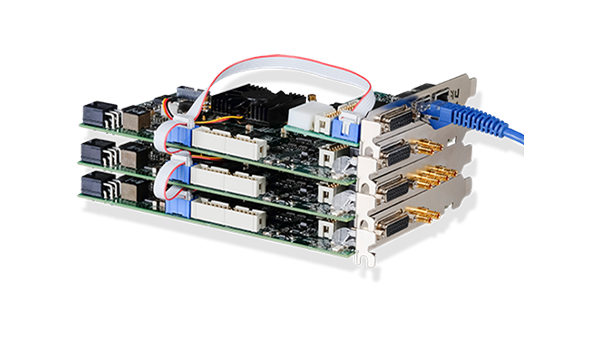
C2C-Link Camera Synchronization
Allows to accurately synchronize multiple area-scan or line-scan cameras connected
-
- to the same card
- to different cards in the same PC
- to different cards in different PCs
Windows, Linux, and macOS drivers available
Including support for Intel 64-bit platforms as well as ARM 64-bit platforms.
Other benefits
Flexible Line-scan camera operation with the rate converter
- The rate converter is a smart, programmable frequency multiplier/divider.
- Used with motion encoders and line-scan cameras, it allows the user to choose the aspect ratio of the pixels in the image.
- It provides a way to calibrate the acquisition chain to easily reach square (1:1 aspect ratio) pixels.
Line-scan Metadata insertion
When activated, this feature records metadata beside image data. Line metadata are captured every acquired image line. Buffer metadata are only captured when the first image line of a buffer is acquired. The metadata are composed with a configurable set of general purpose event counters, quadrature encoder position counters and/or I/O line status. This feature allows line-scan applications to correlate image data with system events including motion encoder positions.
General purpose I/O lines
- Compatible with a wide range of sensors and motion encoders.
- High-speed differential inputs: Quadrature motion encoder support up to 5 MHz.
- Isolated current-sense input with wide voltage input range up to 30V, signaling up to 200 kHz, individual galvanic isolation up to 250 VDC and 170 VAC RMS.
- Isolated contact outputs.
- High-speed 5V-compliant TTL inputs/ LVTTL outputs.
eGrabber
Discover our Frame Grabber software
FAQ
What are the cable options for the Coaxlink QSFP28?
One of the most important benefits of CoaXPress-over-Fiber is the wide variety of connectivity already available from multiple companies. The advantage of using modules compared to fixed interfaces is that cameras and frame grabbers can be equipped with any suitable type of transceiver as required by the application.
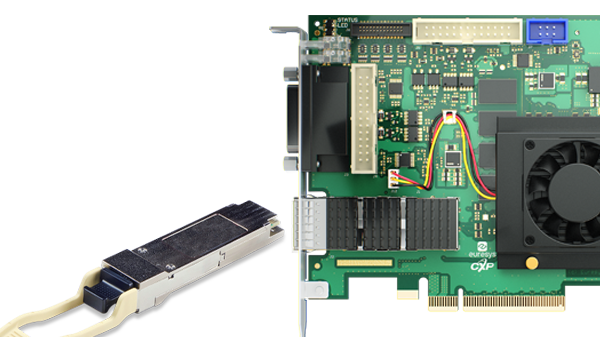
There are basically three types of cable for the Coaxlink QSFP28:
- AOC (Active Optical Cable) where the fiber cable is permanently attached to the optical transceivers.
- MPO/MTP fiber cables with multiple pairs of multi-mode fiber (typically), where the optical transceivers can be disconnected.
- Duplex LC/UPC fiber cables with one pair of single-mode fiber (typically), where the optical transceivers can be disconnected.
What are the benefits of using CoaXPress-over-Fiber for my application?
- Available as CXP to nGMII (device) or nGMII to CXP (host) Bridge IP Cores
- Ultra-high data/frame rates
- Many accessory and cabling options to cover any length requirement
- Low CPU overhead, low latency, low jitter image acquisition
- Highest camera count per PC performance
- Very competitive cost/performance ratio
- Wide industry acceptance due to JIIA standardization
What are the pros and cons of using fiber optics?
Pros
- First and foremost, cable length is not an issue anymore as fiber connectivity is basically not limited in length.
- Fiber optics provide more bandwidth, as connectivity at 10 and 25 Gbps per fiber is standard today and widely used in data centers.
- Fiber optics are immune to electrical noise, which will be a significant advantage on the production floor and in some medical applications.
- Fiber optics are lighter and smaller in size than the equivalent copper cabling, making it appropriate for applications where this characteristic is essential, like in aircrafts or vehicles.
Cons
- There is no "power over fiber". As signals in fiber optics are transmitted using light, there is no way to transfer power over fiber optics and devices such as cameras must be powered separately.
What are the jitter and latency of CoaXPress-over-Fiber? How do they compare to "traditional" CoaXPress?
CoaXPress-over-Fiber is based on the CoaXPress protocol and it exhibits the same high performance as CoaXPress in terms of jitter and latency. In addition, as CoaXPress-over-Fiber supports higher transmission speed compared to CoaXPress.
Need help?
Find technical documentation for CoaXPress and Camera Link frame grabbers
General
| Product name: | PC3628 Coaxlink QSFP28 |
| Product code: | 3628 |
| Product status: | Released |