


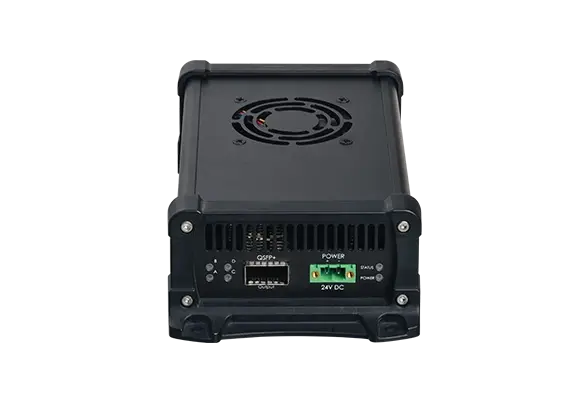
Coaxlink CXP-12 to QSFP+ Converter
Four-connection CoaXPress CXP-12 to CoaXPress-over-Fiber converter
- Provides easy cable length extension using CoaXPress-over-Fiber
- Allows connecting a CXP-12 camera to a Coaxlink QSFP+ frame grabber
- Four CoaXPress CXP-12 connections on the camera side
- One QSFP+ port compliant with 40 Gbps optical modules on the frame grabber side
- 5,000 MB/s camera bandwidth
- PoCXP camera power supply
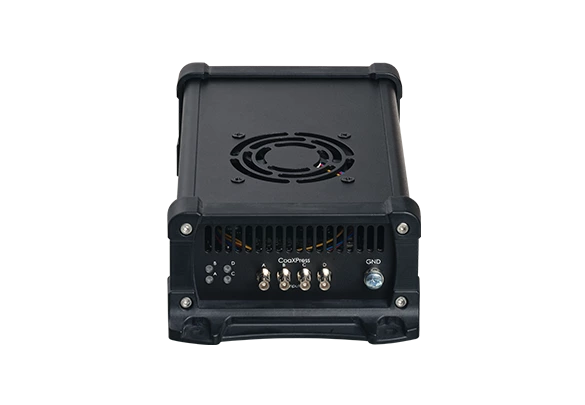
CoaXPress-over-Fiber
CoaXPress-over-Fiber is a light but significant extension of the existing CoaXPress specification to support transport over fiber optics
By using fiber optics connectivity, CoaXPress-over-Fiber benefits from the almost unlimited cable lengths and reduced cable congestion (fiber optics are lighter and thinner than coaxial cables). By leveraging Ethernet Physical Layer standards (IEEE 802.3), CoaXPress-over-Fiber also benefits from the low-cost standard components (such as connectors and cables) and their constant evolution towards higher bandwidths.
Most importantly, CoaXPress-over-Fiber allows CoaXPress to go beyond the physical limitations of coaxial cables in terms of bitrate.
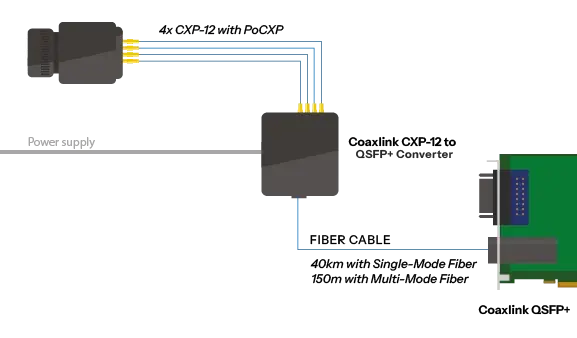
Connect a CXP-12 camera to a Coaxlink QSFP+ frame grabber
The Coaxlink CXP-12 to QSFP+ Converter allows connecting a CXP-12 camera to a Coaxlink QSFP+ frame grabber using fiber optics. With multi-mode fibers, the maximum cable length can reach 150 meters. With single-mode fibers, the maximum cable length can reach 40 kilometers.

Acquire images from the fastest and highest resolution cameras
- Highest data acquisition rate in the industry
- Up to 5,000 MB/s bandwidth from camera to host PC memory
Benefits
Power Over CoaXPress
-
- Feed your camera up to 17 W per channel under 24 VDC with automatic device detection, measurement and overload protection.
- Total and per-channel voltage and current measurement is possible, allowing validation and performance deviation monitoring.
Compliant With GenICam
Including support for:
-
- GenApi
- The Standard Feature Naming Convention (SFNC)
- GenTL
Compatible With eGrabber
- eGrabber Studio: eGrabber’s interactive evaluation and demonstration application, giving access to GenICam features exposed by GenTL Producers
- GenTL Console: A command-line tool giving access to the functions and commands exposed by the Euresys GenTL Producers
eGrabber
Discover our Frame Grabber software

FAQ
What are the cable options for CoaXPress-over-Fiber?
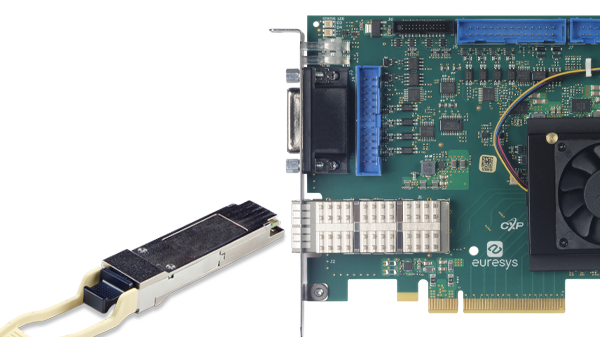
One of the most important benefits of CoaXPress-over-Fiber is the wide variety of connectivity options already available from multiple companies. The initial connectivity options for CoaXPress-over-Fiber and the Coaxlink QSFP+ at 10 Gbps are SFP+ and QSFP+ (Quad, or four times SFP+) modules.
The advantage of using modules compared to fixed interfaces is that ports can be equipped with any suitable type of transceiver as required by the application. A variety of transmitter and receiver types is available, allowing users to select the appropriate transceiver to provide the required optical reach over multi-mode or single-mode fiber.
What is the maximum cable length with single-mode fibers?
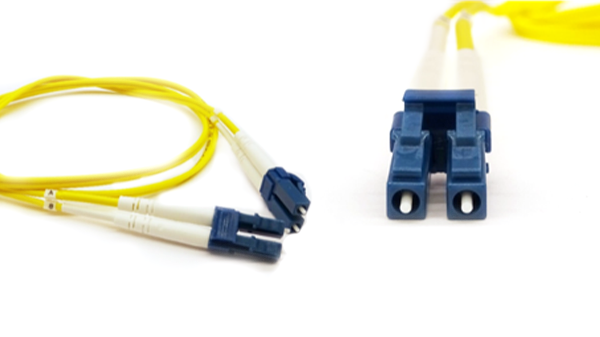
With a standard 40GBASE-ER4 QSFP+ LC DOM Optical Transceiver Module and an LC-Duplex single-mode fiber cable, the maximum cable length is 40 kilometers. This solution is suitable, for example, for video transmission applications.
What is the maximum cable length with multi-mode fibers?
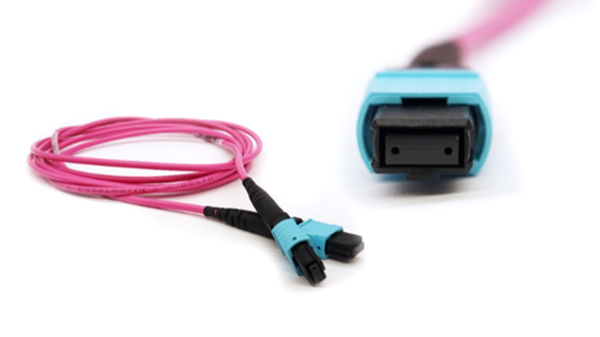
With a standard 40GBASE-SR4 QSFP+ Optical Transceiver Module and an MTP/MPO multi-mode fiber cable, the maximum cable length is 150 meters. This solution is suitable for machine vision applications.
What are the benefits of using CoaXPress-over-Fiber for my application?
- Available as CXP to nGMII (device) or nGMII to CXP (host) Bridge IP Cores
- Ultra-high data/frame rates
- Many accessory and cabling options to cover any length requirement
- Low CPU overhead, low latency, low jitter image acquisition
- Highest camera count per PC performance
- Very competitive cost/performance ratio
- Wide industry acceptance due to JIIA standardization
What are the pros and cons of using fiber optics?
Pros
- First and foremost, cable length is not an issue anymore as fiber connectivity is basically not limited in length.
- Fiber optics provide more bandwidth, as connectivity at 10 and 25 Gbps per fiber is standard today and widely used in data centers.
- Fiber optics are immune to electrical noise, which will be a significant advantage on the production floor and in some medical applications.
- Fiber optics are lighter and smaller in size than the equivalent copper cabling, making it appropriate for applications where this characteristic is essential, like in aircrafts or vehicles.
Cons
- There is no "power over fiber". As signals in fiber optics are transmitted using light, there is no way to transfer power over fiber optics and devices such as cameras must be powered separately.
What are the jitter and latency of CoaXPress-over-Fiber? How do they compare to "traditional" CoaXPress?
CoaXPress-over-Fiber is based on the CoaXPress protocol and it exhibits the same high performance as CoaXPress in terms of jitter and latency. In addition, as CoaXPress-over-Fiber supports higher transmission speed compared to CoaXPress.
Need help?
Find technical documentation for CoaXPress and Camera Link frame grabbers
General
| Product name: | PC3629 Coaxlink CXP-12 to QSFP+ Converter |
| Product code: | 3629 |
| Product status: | Released |