


CoaXPress-Over-Fiber Bridge Host IP Core
CoaXPress-Over-Fiber Bridge Host IP Core For FPGA
- nGMII to CXP Bridge IP Core
- Compatible with AMD 7 Series (and newer)
- Compatible with Altera Cyclone/Arria 10/Agilex
- Compatible with S2I and third-party CoaXPress Host IP Cores
- Delivered as working reference design (when licensed with the S2I CoaXPress Host IP Core) and extensive simulation testbench
Architecture
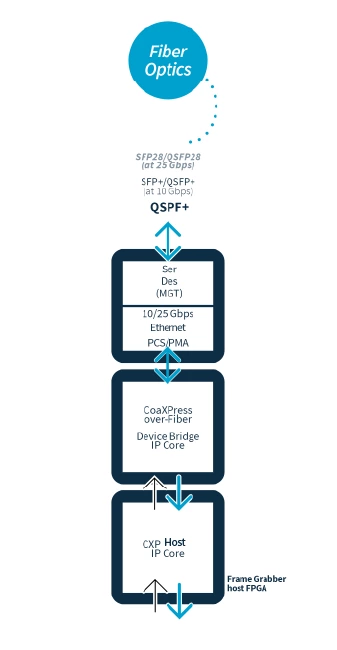
The CoaXPress-over-Fiber Host Bridge IP Core allows to connect a CoaXPress Host IP Core to an nGMII (10/25 Gbps Media Independent Interface) bus inside an FPGA. nGMII, as defined in IEEE Std 802.3 Clause 46, is the main access to the 10/25G Ethernet physical layer. The generic nature of this interface facilitates mapping the CoaXPress signaling into the PCS/PMA Ethernet sublayers. The IP converts nGMII packets received from an Ethernet PCS/PMA block, back to CoaXPress packets.
Resource Usage
Benefits
What Is CoaXPress-Over-Fiber?
CoaXPress-over-Fiber is a light but significant extension of the existing CoaXPress specification to support transport over fiber optics.
CoaXPress (CXP) is the de-facto standard for high-bandwidth computer vision applications. CoaXPress 2.1, the latest version of the specification, specifies the CXP-12 speed, a 12.5 Gbps (Gigabit per second) connection over a coaxial copper cable. As link aggregation is common with CoaXPress, bandwidths of 50 Gbps (12.5 x 4) are easily achievable with four CXP-12 connections. CoaXPress-over-Fiber has been designed as an add-on to the CoaXPress specification. It provides a way to run the CoaXPress protocol, as it is, unmodified, over a standard Ethernet connection, including fiber optics. As such, CoaXPress-over-Fiber uses standard electronics, connectors and cables designed for Ethernet, but the protocol is CoaXPress, not Ethernet, not GigE Vision.
What Are The Benefits Of Using CoaXPress-Over-Fiber For My Application?
- Available as CXP to nGMII (device) or nGMII to CXP (host) Bridge IP Cores
- Ultra-high data/frame rates
- Many accessory and cabling options to cover any length requirement
- Low CPU overhead, low latency, low jitter image acquisition
- Highest camera count per PC performance
- Very competitive cost/performance ratio
- Wide industry acceptance due to JIIA standardization