


Logo Allied Vision eVision Image Analysis Software Tools
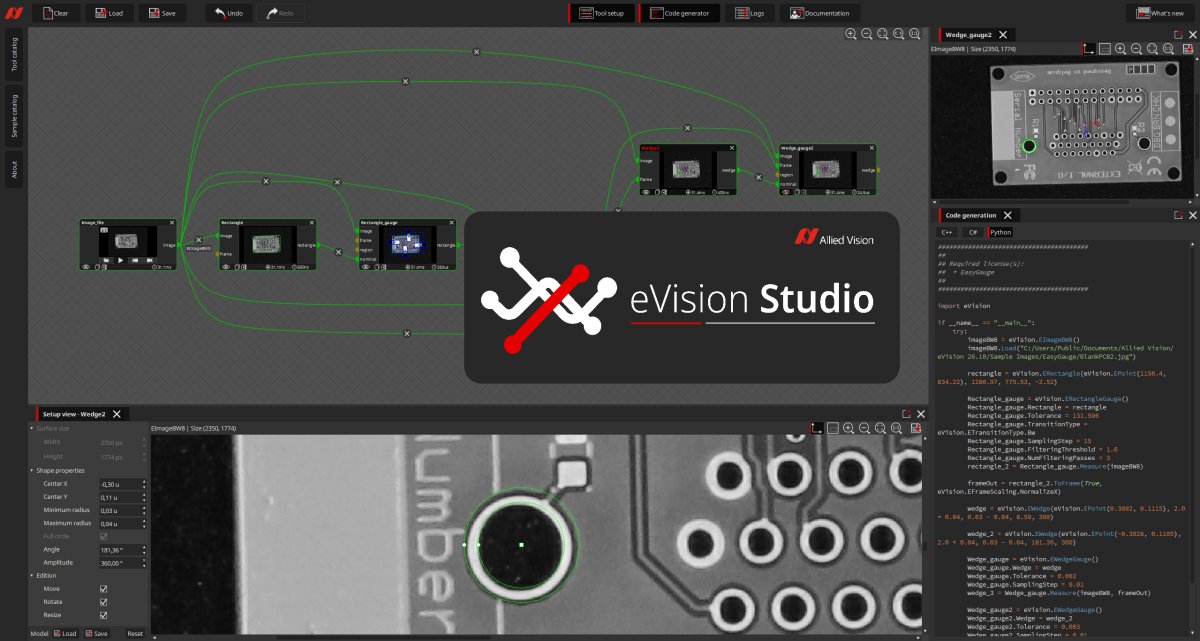
Screenshot eVision Studio
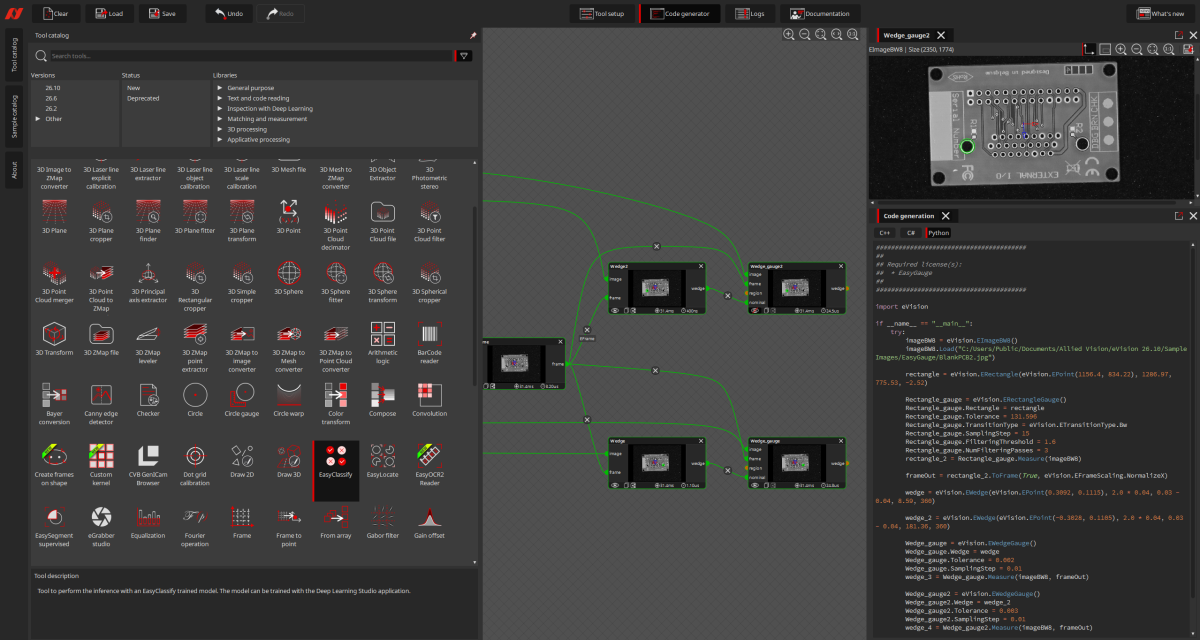
Screenshot eVision Libraries
Now available: Allied Vision’s eVision Machine Vision Software Release 26.10.
First Allied Vision branded release marks another step toward full integration of Euresys under the Allied Vision brand.
With eVision 26.10 Allied Vision now releases the latest version of its machine vision software, including eVision Libraries, eVision Studio, and eVision Deep Learning Studio. Being part of the Allied Vision Ecosystem the software now comes in an Allied Vision branded design for the first time and thus marks a further step towards the full integration of Euresys under the Allied Vision brand.
Formerly known as Euresys Open eVision, the software becomes an integral part of the Allied Vision portfolio, featuring a redesigned user interface, updated technical IDs, and new installation folder structures. The release strengthens Allied Vision’s commitment to providing a comprehensive machine vision ecosystem with a single point of contact for customers’ vision-related needs, from hardware to software.
Enhanced libraries and improved usability
eVision 26.10 introduces several improvements designed to simplify machine vision development and address specific customer requirements. EasyQRCode receives enhancements to improve QR code reading, while EasyBarCode adds support for additional barcode symbologies, including GS1 DataBar Stacked. The EasyImage library introduces line detection for applications such as surface inspection and scratch detection, as well as a hole-filling function for image processing and mask generation. Updated user and reference guides provide additional support for developers.
More capabilities in eVision Studio
The eVision Studio development environment gains new tools, including EasyOCR2 for optical character recognition, RTSP for accessing live video streams, Shape to Frame, and line detection. Improved tool and sample catalogs make it easier to explore available functions, test algorithms, and accelerate application development. All new features are accessible through eVision Studio, which is available free of charge, allowing users to evaluate the software’s capabilities in practical workflows.
Technical overview: eVision 26.10
|
Product: Allied Vision eVision 26.10 |
|
New image-processing functions: Line detection and hole filling |
|
Code-reading improvements: Enhanced QR code reading and additional barcode symbologies |
|
New eVision Studio tools: EasyOCR2, RTSP, Shape to Frame, line detection, and more |
|
Evaluation and prototyping tool: eVision Studio, available free of charge |
|
Documentation: Updated user guide and reference guide |
|
Availability: Download from www.alliedvision.com |
eVision 26.10 installation packages are available for download from the Allied Vision website on www.alliedvision.com. Existing support services remain unchanged, with the additional benefit of access to the wider Allied Vision ecosystem.
eVision – an innovative Machine Vision Software for your inspection application
eVision is a set of hardware-independent image processing and analysis libraries for machine vision inspection applications. Our Machine Vision Software is compatible with any image source, including frame grabbers, GigE Vision, and USB3 Vision cameras.
The general-purpose libraries cover applications such as image filtering and enhancement. The matching and measurement tools contain blob analysis, pattern matching, alignment and sub-pixel measurement functions. The text and code reading libraries include functions for optical character recognition and 1D / 2D barcode reading and grading. The 3D libraries include laser line extraction and calibration functions, point cloud processing and management functions, and 3D object extraction, alignment and inspection functions. The Deep Learning libraries are Convolutional Neural Network-based inspection libraries for image classification and segmentation.
eVision contains a set of 64-bit libraries for C++, Python and .NET (C#, VB.NET, C++/CLI) under Windows (x86-64) and Linux (x86-64 and ARMv8-A). They are designed to be easy to learn and use, facilitating quick integration into your projects.